


Maintaining a saltwater spa: the complete guide (with example of the Intex Chevron Deluxe)
A saltwater spa is wonderfully relaxing and a lot easier to maintain than many people think. Yet at Pool.shop, we receive questions about the right approach almost every day: Does it need chlorine or not? Why do my walls feel slippery? How do I lower the pH? In this guide, we explain step by step how to maintain a saltwater spa, how often you need to do what, and which products you need for it. We use the Intex PureSpa Chevron Deluxe as an example, but the principles apply to virtually every inflatable saltwater spa.
One misconception first: “saltwater” does not mean “no chlorine”. Your spa produces chlorine itself from the salt. You can read how this works below.
How does a saltwater spa actually work?
With a saltwater system (also known as a salt chlorinator), there is simply salt in the water. A component in the pump unit — the electrolytic cell — sends a small current through the salty water and converts the sodium chloride (salt) into chlorine. This chlorine disinfects your water and then breaks down again into salt, after which the cycle starts again.
The big advantage: you don't have to constantly dose chlorine tablets, the water feels softer and smells less sharp. But — and this is important — there is indeed chlorine in your water. It is simply produced by your spa itself instead of you adding it by hand.
For proper operation, the system needs the right salt level: between 2 and 3 g/L (2000–3000 ppm), with 2.5 g/L (2500 ppm) as ideal. Too little salt and your spa produces too little chlorine; too much salt corrodes the metal components and displays error code E92 (too high) or E91 (too low) on the screen.
I have a saltwater spa, so just salt and no chlorine tablets… is that right?”
This is by far the most frequently asked question, so we'll answer it straight away. It's largely true: you add salt and the salt chlorinator continuously produces chlorine. So you don't need to put chlorine tablets in a floater as you would with a classic pool. However, in these two situations you still dose chlorine manually:
- After refreshing the water or during intensive use with many bathers. The cell may then temporarily not be able to produce chlorine quickly enough. A shock treatment (see below) quickly brings the water back up to level.
- If your test strip shows too little free chlorine (target value 2–4 ppm). Then you either increase the running hours of the salt chlorinator, or give a manual dose of chlorine granules.
In short: the salt is your daily engine, but a tub of chlorine granules for spas belongs in every spa cabinet as a backup.
Step 1 — Test your water (weekly)
Maintenance always starts with measuring. Without testing, you don't know what your water needs. Use test strips and test at least once a week (more often with intensive use, daily if necessary). With a good strip, you measure the key values in one go. Dip the entire strip briefly into the water, remove it immediately, hold it horizontally for 15 seconds (do not shake), and compare the colours with the packaging. The target values for your spa are:
| Value | Target range |
|---|---|
| Free chlorine | 2 – 4 ppm |
| pH | 6,8 – 7,6 |
| Total alkalinity (TA) | 60 – 120 ppm |
| Calcium hardness | 150 – 250 ppm |
| Salt level | 2000 – 3000 ppm (ideal 2500) |
👉 Order your AquaChek test strips (4-in-1) or the special test strips for saltwater.
Step 2 — Keep the salt level up to standard
When filling for the first time, spread the salt evenly over the bottom (guideline: 2 kg for the 4-person model, 2.5 kg for the 6-person model). Switch on the bubble/circulation function, brush the bottom so the salt doesn't accumulate, and let it dissolve completely for about an hour before switching on the salt chlorinator. After that, you only need to make adjustments:
- Code E91 (too low): add 0.5 kg of salt at a time until the message disappears.
- Code E92 (too high): drain approximately 25% of the water and top up with fresh water until the message disappears.
Always use pure pool salt (sodium chloride in accordance with EN16401). Not bath salt, not “non-chloride ion salts”.


Step 3 — Increasing or decreasing pH
The pH indicates how acidic or basic your water is. The correct range is 6.8 – 7.6. If you're above or below this, your chlorine works less effectively and you'll get limescale build-up, cloudy water or skin and eye irritation more quickly. Important order: always adjust the total alkalinity (TA) first, then the pH. TA acts as a buffer; if it's not right, your pH will keep fluctuating.
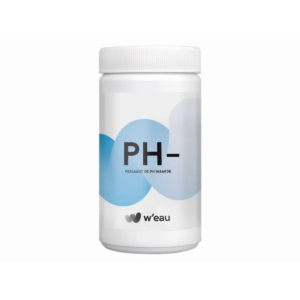
- pH too high (> 7.6)? Add pH-minus to lower it.
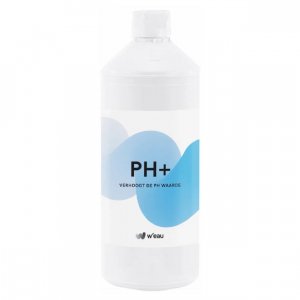
- pH too low (< 6.8)? Add pH-plus to raise it.
- TA too high (> 120 ppm)? Use a TA reducer (often the same as pH-minus).
- TA too low (< 60 ppm)? Use a TA increaser.
Always add chemicals to the water with the circulation running, never while people are in the spa. Test again after 24 hours and adjust further if needed.


Step 4 — Increasing or decreasing chlorine level
Target value is 2–4 ppm free chlorine.
Chlorine too low?
- Increase the running hours of the salt system (adjustable to 3, 5 or 8 hours per day — for the first time and with low values, set it to 8 hours).
- Or give a manual dose of chlorine granules.
Chlorine too high?
- Reduce the running hours of the salt system.
- Let the spa "air out" for a while with the cover removed; chlorine breaks down naturally.
Note: a high pH makes your chlorine less effective. Above pH 7.5, less than half of your chlorine is still active. So always address your pH first if your chlorine "doesn't seem to be working".



Step 5 — Shock treatment when refreshing the water
Yes, a shock treatment is recommended — especially after refreshing the water and after intensive use. A shock treatment gives your water a short, powerful burst of chlorine that breaks down accumulated organic residues (sweat, skin oils, cosmetics) that your salt system doesn't keep up with.
Do this each time you refresh the water, and in between whenever your water becomes cloudy or starts to smell. Then switch the salt system back on for daily maintenance.
Step 6 — Clean the filter (weekly)
The filter captures all fine dirt and is crucial for clear water. Check and clean the filter cartridge once a week:
- Press the lever, pull the cartridge housing loose and remove the filter.
- Rinse the filter thoroughly with the garden hose.
- If the filter remains discoloured or dirty, it's time for a new one.
Always keep spare filters in stock — a clean filter saves energy and keeps your water clear.
👉 For the Intex PureSpa: Intex Pure spa filter S1 (set of 6) or the value pack of 12.


Step 7 — Clean the electrolytic cell (every 1–2 weeks)
In areas with hard water (a lot of lime), deposits form on the titanium plate of the cell. As a result, your spa produces less chlorine. The cell has a self-cleaning function, but with hard water you occasionally need to lend a hand:
- Water hardness < 100 ppm: check the cell every two weeks.
- Water hardness > 350 ppm: check weekly.
Clean it as follows: switch off the spa and unplug it, seal off the inlet and outlet with the supplied caps, disassemble the cell and place the titanium plate in ordinary cleaning vinegar for at least an hour until the deposits have disappeared. Then rinse with tap water (keep the cell's plug dry!) and reassemble everything.
Step 8 — Refresh the water (every 2–3 months)
However well you dose, at some point the water becomes "saturated" with dissolved substances. So refresh the entire water every 2 to 3 months, or sooner if it becomes cloudy and can no longer be made clear with chemicals.
When emptying: switch off the spa, connect a garden hose to the drain adapter and let the water drain to a suitable location. Take the opportunity to clean the empty tub with a soft sponge and a mild agent, and rinse thoroughly before refilling. After refreshing: add salt, set the values and give a shock treatment.
Step 9 — Cover and surroundings
The cover keeps warmth in and dirt out. Clean it regularly on the inside and outside with a sponge and a suitable disinfecting solution. Inspect it for wear or damage — a damaged cover insulates poorly and is unsafe (especially with children nearby). A well-fitting cover also saves considerably on your energy consumption.
Also keep the area around the spa clean. Always rinse dirt and cleaning water away from the spa, so that no dirt or cleaning agent ends up in the water.
Step 10 — Winterising and storage
In areas where it can freeze, store the spa as soon as the temperature drops towards 4°C. Brief step-by-step plan:
- Empty and clean the spa completely.
- Blow out the residual water from the pipes with the supplied hose.
- Leave all parts to dry in the open air for at least an hour (drying with a cloth alone is not enough and may damage the tub).
- Fold the tub loosely, avoiding sharp creases.
- Store everything dry between 0 and 40 °C, preferably in the original packaging.
- Make sure you have enough clean filters in stock for the next season.
Maintenance schedule at a glance
| How often | What |
|---|---|
| Daily / after each use | Replace the cover, charge the control panel, take a quick shower before use |
| Weekly | Test water with test strips, clean the filter, adjust pH/chlorine |
| Every 1–2 weeks | Check and descale the electrolytic cell (more often with hard water) |
| Monthly | Treat pipes against biofilm, thoroughly clean the cover |
| Every 2–3 months | Completely refresh the water + shock treatment |
| In case of frost / winter | Empty, dry and store the spa indoors |
The spa maintenance cabinet: what you need at home
With these basics, you're prepared for the whole season:
- Salt — W’eau pool salt 20 kg
- Test strips — AquaChek 4-in-1
- Chlorine granules (backup & shock) — AquaFinesse chlorine granules
- Biofilm & pipe cleaner — AquaFinesse Spa & Hottub set
- Replacement filters — Intex Pure spa filter S1
- Protective cover — Intex insulating protective cover
Still looking for the spa itself? Check out the Intex PureSpa Chevron Deluxe (4-person) or the 6-person version.
Finally
Maintaining a saltwater spa is mainly a matter of routine: weekly testing, keeping the filter clean, descaling on time and refreshing the water every few months. Remember that “saltwater” does not mean “chlorine-free” — your spa produces the chlorine itself, and with a tub of chlorine granules and a biofilm cleaner on hand, you can effortlessly keep slippery walls and foam at bay.
Not sure about a value or a product for your specific situation? The specialists at Pool.shop are happy to think along with you.
For your specific model, always also consult the official Intex manual and follow the manufacturer's instructions for each chemical product.


